


By [Your Name/Pen Name]
We are going to take a dive into dangerous waters. Before we start: If you have an issue even discussing treating young children with cannabis, I need to ask you to do one thing. Take your head out of the sand and do some research. This conversation isn’t about getting kids high. It’s about science. It’s about survival.
If you don’t believe that, look up the name that started it all: Charlotte Figi.
Her story should break your heart and make you cry. By the time she was five, she was having hundreds of grand mal seizures a week, on top of severe autism. Doctors had tried every single pharmaceutical drug in the arsenal. Those drugs did more than fail; some of them literally caused her to flatline—killed her—multiple times. The medical system had given up.
But her mother didn’t. In a desperate act of love, she chose to break federal law and obtained non-psychoactive cannabis. It changed Charlotte’s world instantly. The first marketable CBD product was created for her by the Stanley Brothers out of Colorado. The world now knows it as Charlotte’s Web. Charlotte didn’t survive; she thrived, giving voice and hope to millions before she eventually passed. But the foundation she built remains: cannabis is medicine, and it is a travesty that we continue to ignore its proactive potential.
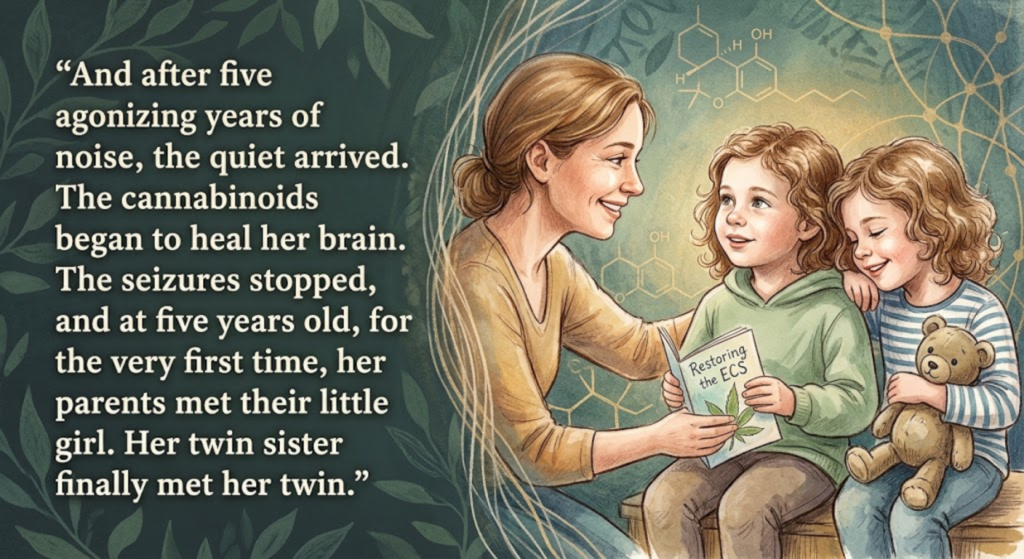
And after five agonizing years of noise, the quiet arrived. The cannabinoids began to heal her brain. The seizures stopped, and at five years old, for the very first time, Charlotte’s parents met their little girl. Her twin sister finally met her twin.
The conventional approach to managing autism and its severe comorbidities is reactive. We wait for the breakdown, then use drugs to suppress the behavior. It’s time to be proactive. It’s time to treat the biology causing the pain.
Beyond the Behavior: The Biology of Discomfort
The current conversation surrounding autism therapy is heavily focused on behavior. What often gets lost is that much of the behavior observers flag as problematic is actually a child’s direct communication about profound physical and internal distress. Many autistic children are not simply being “difficult”; they are suffering from a system-wide imbalance that often begins with a fundamental biological component: the Endocannabinoid System (ECS).
The ECS is a vast regulatory network—perhaps the most vital—that manages balance (homeostasis) for critical bodily functions, including mood, sleep, pain, immune response, and digestion. In fact, research suggests a possible link between some autism diagnoses and a state known as Clinical Endocannabinoid Deficiency (CECD).
Why Are These Systems Starving?
Many autistic individuals have complex issues surrounding sensory integration and digestion. This often translates to a severely limited, “beige” diet—lacking essential nutrients, healthy fats, and prebiotic fiber needed to maintain a healthy ECS and gut microbiome. This “starving” of the system often creates a cascade of interrelated health problems.
The Consequences of a Faltering System
When the endocannabinoid system isn’t running on all cylinders, the regulation of vital functions falters. For subsets of the autistic population, this “CECD” may manifest as clusters of severe side effects, which you may recognize in your own child or in others:
- Bowel Dysfunction and Constipation: The gut is lined with endocannabinoid receptors. A weak ECS slows down gastrointestinal motility, leading directly to the painful, chronic “bunging up” that so many families struggle to manage.
- Severe Anxiety and Emotional Swings: The ECS modulates the “fight or flight” response. Deficiency leaves the child hyper-reactive to their environment, locked in a state of high alarm.
- Chronically Disrupted Sleep: Endocannabinoids are critical for initiating sleep and regulating sleep cycles. CECD often means problems falling and staying asleep.
- Seizures and Epilepsy: (The very issue Charlotte battled). There is a significant overlap between autism and epilepsy. The ECS is responsible for modulating neuronal excitability, making its deficiency a risk factor for seizure activity.
- Immune Dysfunction and Chronic Inflammation: An out-of-balance ECS often fails to regulate the immune system, leading to heightened inflammation throughout the body and brain.
Healing the System: The Role of Cannabinoids (No THC Needed)
If the endocannabinoid system is “starving,” the most logical treatment is to feed it. This is where we must dismantle the stigma that nearly killed Charlotte.
Treating an autistic child with cannabis does not mean getting them high. THC is not needed.
A full-spectrum cannabinoid regimen, specifically excluding THC (or keeping it in very low, non-psychoactive ratios), is entirely possible. The real therapeutic power lies in utilizing the vast spectrum of non-intoxicating compounds:
- Cannabidiol (CBD): The main player. CBD does not cause impairment. Instead, it interacts indirectly with the ECS. It inhibits the enzyme (FAAH) that breaks down anandamide, the body’s own critical endocannabinoid. By boosting the body’s internal supply of its own balancing molecule, CBD supports homeostasis.
- Cannabigerol (CBG): Often called the “stem cell cannabinoid,” CBG is known for its strong anti-inflammatory and neuroprotective properties.
- Cannabichromene (CBC): Research suggests CBC works alongside other cannabinoids to potentially boost neurogenesis (the growth of new brain cells) and reduce inflammation.
By using these non-intoxicating compounds, we are not introducing impairment. We are restoring regulatory control. We are providing the “starving” ECS with the supplementary input it needs to manage pain, reduce inflammation, improve gut motility (treating constipation), calm the hyper-reactive nervous system (addressing anxiety), and initiate sleep.
It’s time to move past the stigma and start looking at the biology. We can’t keep waiting for the lines to blow while ignoring the physical agony caused by a regulatory system running on empty.
Looking for honest dialogue?
If you're ready to look past the industry narratives and talk real behavioral mechanics—whether you're neurodivergent yourself or a working practitioner—my door is open.
- Email: info@autismradical.com
- Join the mirror: Autism Radical: Reclaiming Behavioral Science on Facebook
Come as you are. No judgment, just pure mechanics and open discussion.